Problem Severity Calculation Method
|
The Problem Severity Calculation Section |
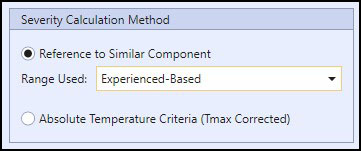
Aspect has the ability to calculate problem severity using one of two methods chosen by the thermographer on a per-problem basis:
- Reference Component
Severity calculation by reference component is probably the most common way to calculate a problem's severity. A temperature measurement of a reference component, which is a similar component to the problem component under similar load, is documented and the delta between the reference temperature and problem temperature is used to determine the severity of the problem.
|
|
Even though the amperage load is entered for the problem component and reference components, it is not used to calculate the problem severity. |

Aspect has the ability to document up to two reference components. If you choose to document two reference components, then the average temperature between the reference components is calculated, and that average is then used to calculate the delta between the problem component.
This method of calculation can also utilize several ranges for determining the severity of a problem:
- NETA (Component to Component)
- NETA (Ambient Air Temperature)
- Military Standard
- Experienced-Based
- Motor Cores
- Custom Ranges (either Component to Component, or Ambient Air)
The NETA (Ambient Air Temperature) range does not use reference component(s) to make the severity calculation, but rather the ambient air temperature. When choosing this range, the sections for entering reference components will be disabled. The specific temperatures for these ranges can be seen in the topic Problem Severity Ranges.
- Absolute Temperature Criteria
This method, also known as Tmax Corrected, does not use a reference component to calculate the severity of the problem, but rather a known temperature called the Rated Rise to make the calculation. The rated rise of a component is easiest to determine if you use the Component Type tables. You also have the option of entering that value manually. For this calculation, the RMS load of the component is also used.
|
|
When using absolute temperature criteria, the calculated severity will be either Pass or Fail. Severity ranges such as minor, important, serious, and critical are not applicable when using absolute temperature criteria calculations. |
|
|
The formula used for calculating Tmax Corrected uses the square of the quotient of the measured load over the rated load (in amperes). This is an approximation formula provided by the Infraspection Institute in their document Standard for Infrared Inspection of Electrical Systems & Rotating Equipment, 2016 Edition. The exact formula uses an exponent that varies around 1.7 - 1.8 depending on the material in the component. In most cases, the approximation using the square should be sufficient for documenting the problem. However, it will not be exact and this documentation is intended to be a disclaimer to this fact. As a thermographer, make sure you are fully aware of the approximate nature of this calculation and the margin of error it could potentially introduce. |